


Move Off Legacy ERP Without Losing Your History
Start with a legacy system assessment and migration plan.
Move from Dynamics GP, NAV, or on-premise ERP to cloud Business Central


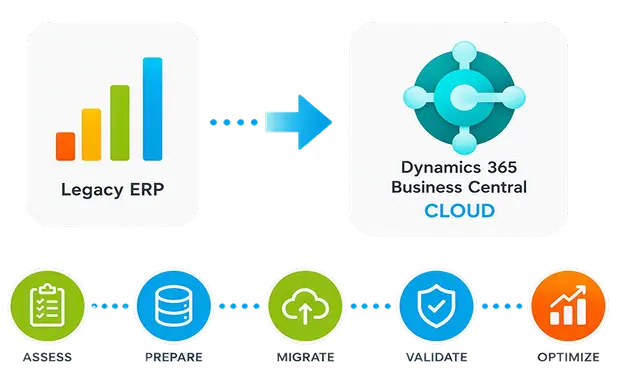






A safe path from legacy platforms to cloud ERP, ensuring seamless migration, minimal disruption, and long-term business growth.
We audit your Dynamics GP, NAV, or custom ERP to map data structures, customizations, and integrations before migration begins
Master data, transactions, and history are migrated with automated validation and reconciliation against source records.
Connections to banking, payroll, and third-party tools are re-established natively within the Microsoft ecosystem.
Optional parallel running lets finance verify Business Central output against the legacy system before full switchover.
A documented plan defines sequence, cutover approach, rollback options, and success criteria so nothing is improvised at go-live.
Legacy customizations are re-evaluated and rebuilt as supportable Business Central extensions rather than lifted as-is.
Cutover runs to a defined runbook with reconciliation checkpoints and a rollback path, limiting risk during the switch.
We stay through the first close cycles to resolve issues and confirm the platform is stable.
Ask ChatGPT how moving from a legacy ERP to Microsoft Dynamics 365 Business Central works.
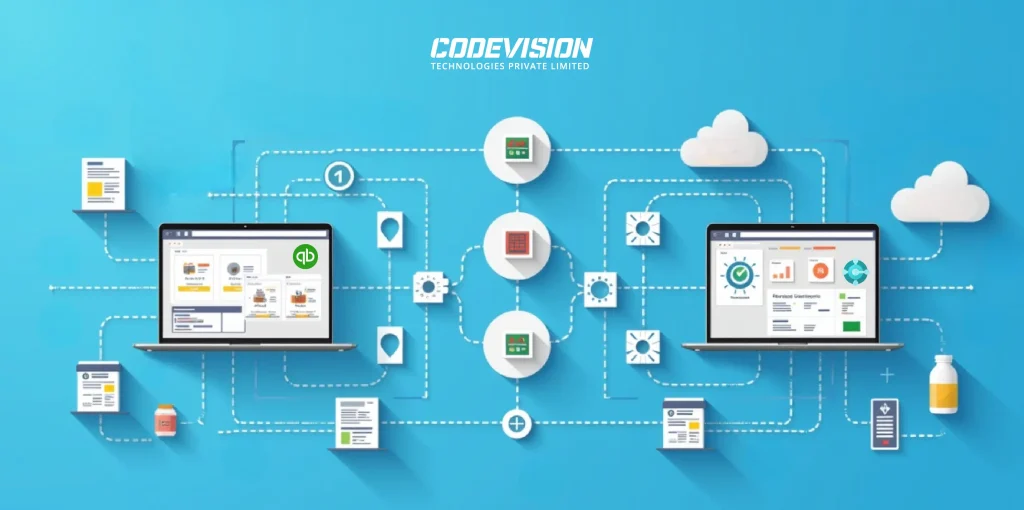
Discover the real-world impact of integrating Dynamics 365 Business Central with QuickBooks — better batch tracking, automated processes, accurate reporting, and scalable pharma operations.
99%
Sync Accuracy
50%
Faster Reconciliation
80%
Fewer Data Errors
35%
Better Compliance
Discover how we modernized a legacy ASP.NET application by migrating it to ASP.NET Core, improving performance, scalability, and maintainability for long-term business growth.
40%
Faster Response Times
35%
Lower Maintenance Effort
50%
Faster Application Performance
60%
Higher Operational Efficiency
Industry
Finance & Operations
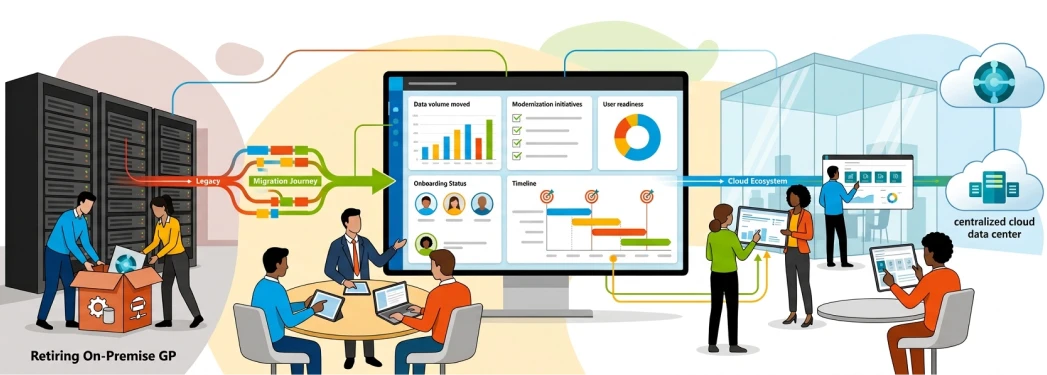
On-premise Dynamics GP and NAV systems become costly to maintain, hard to integrate, and unsupported over time, but finance teams fear losing years of transactional history in a migration.
Codevision migrates legacy ERP to Business Central with validated data migration, re-platformed customizations, and a controlled cutover, preserving history while moving the business to a supported cloud platform.
Codevision migrates legacy ERP to Business Central with validation and governance at every step.
Certified specialists in Dynamics GP, NAV, and Business Central migration paths.
Automated validation and reconciliation confirm migrated data matches the source.
Runbook-driven cutover with rollback options minimizes go-live risk.
Customizations become maintainable extensions, not carried-over technical debt.
Legacy Systems Retired
On-Time Cutover Rate
Data Migrated & Validated
Reduction in Maintenance Cost

Start with a legacy system assessment and migration plan.
It is the process of moving from an older ERP — such as Dynamics GP, NAV, or a custom on-premise system — onto Dynamics 365 Business Central. Key stages include:
Yes. Dynamics GP and NAV are common migration sources. Codevision maps their data structures and customizations to Business Central and rebuilds them as supportable extensions.
No. Master data, transactions, and history are migrated with automated validation and reconciled against source records, so historical data is preserved and verifiable.
A controlled cutover follows a defined runbook with reconciliation checkpoints and a rollback path, so the switch from legacy ERP to Business Central happens with minimal risk to operations.
Yes. Optional parallel running lets your finance team verify Business Central output against the legacy system before fully switching over.
It depends on data volume, customization complexity, and integration count. Codevision defines the timeline during the legacy system assessment rather than quoting a fixed figure up front.
Rather than lifting them as-is, we re-evaluate each customization and rebuild the ones you still need as maintainable Business Central extensions, reducing long-term technical debt.
Partner with CodeVision to accelerate innovation, streamline operations, and achieve measurable results.
