


What Is a Microsoft Frontier Firm? 7 Characteristics of AI-First Organizations

The business world is entering a new era. For years, organizations focused on digital transformation by moving to the cloud, modernizing applications, implementing CRM and ERP systems, and automating manual processes. While these initiatives improved efficiency, many businesses still struggle with fragmented knowledge, disconnected workflows, slow decision-making, and information overload.
Today, artificial intelligence is changing what’s possible.
Microsoft calls this next evolution Frontier Transformation, where organizations move beyond digitization and build intelligent systems that combine AI, enterprise data, human expertise, and intelligent agents to drive measurable business outcomes at scale.
Organizations embracing this model are often referred to as Microsoft Frontier Firms. Microsoft’s vision emphasizes outcome-driven AI systems, enterprise intelligence, trust platforms, and human-agent collaboration as key drivers of business transformation.
In this article, we’ll explore what a Microsoft Frontier Firm is, the key characteristics of AI-first organizations, and how businesses can begin building a future-ready operating model using Microsoft’s AI ecosystem.
What Is a Microsoft Frontier Firm?
A Microsoft Frontier Firm is an organization that embeds AI across business operations, decision-making, employee experiences, and customer interactions to improve productivity, accelerate innovation, and create measurable business outcomes.
Unlike traditional organizations that treat AI as a standalone tool or department-specific solution, Frontier Firms create environments where humans and AI continuously work together through connected data, intelligent workflows, and enterprise knowledge systems.
Microsoft describes this transformation as creating an organization where intelligence continuously compounds over time through connected applications, workflows, enterprise data, and AI systems.
If you’re new to the concept of Frontier Transformation, start by reading our guide on Digital Transformation vs Frontier Transformation to understand how organizations are evolving beyond traditional digital initiatives.
7 Characteristics of a Microsoft Frontier Firm
1. AI Is Connected to Measurable Business Outcomes
One of the biggest differences between AI experimentation and genuine Frontier Transformation is the focus on measurable business results.
Many businesses ask:
“How can we use AI?”
Frontier Firms ask:
“What business outcomes are we trying to improve?”
Successful AI-first organizations align AI initiatives with objectives such as:
- Improving employee productivity
- Reducing operational costs
- Accelerating revenue growth
- Enhancing customer experience
- Increasing forecasting accuracy
- Streamlining business operations
Microsoft consistently positions outcome-driven AI systems as a core principle of Frontier Transformation.
Organizations looking to modernize business processes often leverage the Microsoft Power Platform to automate workflows, build business applications, and create scalable transformation initiatives. To understand its broader role, explore our article on Microsoft Power Platform & Frontier Transformation.
2. Human-Agent Teams Become the New Operating Model
One of the most important trends shaping the future of work is the emergence of human-agent teams in enterprise organizations.
AI is not replacing employees. Instead, it’s amplifying their capabilities.
- Humans contribute:
- Strategic thinking
- Creativity
- Business expertise
- Relationship building
- Decision-making
AI contributes:
- Knowledge retrieval
- Analysis
- Process execution
- Content generation
- Recommendations
For example, employees using Microsoft Copilot can summarize meetings, analyze information, draft documents, and access enterprise knowledge faster than ever before.
As organizations mature, they increasingly invest in Microsoft 365 Modern Workplace solutions to ensure employees have access to connected collaboration, productivity, and AI-powered workplace experiences.
3. Enterprise Intelligence Becomes a Strategic Asset
Most organizations already possess valuable knowledge.
The challenge is accessibility.
Critical business intelligence is often spread across:
- SharePoint
- Dynamics 365
- Teams
- Emails
- Documents
- ERP systems
A defining characteristic of a Frontier Firm is the creation of an enterprise intelligence platform for AI-first organizations, where employees can access information, expertise, and contextual business insights when they need them.
Microsoft refers to this as building an Intelligence Platform that connects knowledge, data, applications, and workflows into one intelligent ecosystem.
Organizations investing in SharePoint Development, Microsoft Dataverse, and modern workplace solutions are better positioned to unlock organizational knowledge, improve collaboration, and create a foundation for enterprise AI.
4. AI Operates Across the Entire Business Stack
Frontier Firms don’t limit AI to a single department.
Instead, they pursue an enterprise-wide AI transformation strategy that embeds intelligence across sales, service, finance, operations, supply chain, and employee experiences.
Sales
Organizations increasingly rely on AI-powered CRM systems to improve:
- Lead qualification
- Pipeline forecasting
- Customer engagement
- Proposal generation
Businesses using Microsoft Dynamics 365 Services and Dynamics 365 Sales CRM can combine customer data, AI recommendations, and business process automation to drive revenue growth.
Operations
AI supports:
- Workflow optimization
- Resource planning
- Intelligent reporting
- Business process automation
Organizations leveraging Dynamics 365 Business Central and integrated Microsoft solutions create a more connected operational environment where decisions are informed by real-time data.
Microsoft’s Frontier Company vision highlights the importance of connecting data, workflows, and business decisions across the entire technology stack.
5. Agentic Workflows Replace Traditional Automation
Traditional automation follows predefined logic.
Frontier Firms increasingly adopt agentic workflows in business that understand context, retrieve information, and coordinate complex tasks across systems.
Unlike traditional automation solutions, AI agents can:
- Understand intent
- Access enterprise knowledge
- Analyze business data
- Recommend actions
- Execute multi-step workflows
Platforms such as Microsoft Copilot Studio, Microsoft Power Automate, and the broader Microsoft Power Platform are enabling organizations to build enterprise AI agents, automate processes, and orchestrate intelligent business operations.
For organizations exploring AI-powered automation, we recently discussed how Power Platform is helping businesses accelerate Frontier Transformation through intelligent workflows and low-code innovation.
6. Trust and Governance Are Built into AI Operations
AI adoption without governance creates risk.
Successful organizations establish an AI governance framework for Frontier Transformation that balances innovation with security, compliance, and responsible AI practices.
Key governance considerations include:
- Data security
- Compliance management
- Responsible AI principles
- Access controls
- Risk monitoring
- AI oversight
Microsoft consistently emphasizes that intelligence and trust must work together to create scalable AI systems.
Organizations that establish governance early are better positioned to scale AI initiatives securely across the enterprise.
7. Continuous Improvement Becomes Part of the Organization’s DNA
The most successful Frontier Firms understand that transformation is never finished.
Rather than treating AI as a one-time project, they adopt a continuous improvement framework for AI-driven business transformation.
These organizations continuously:
- Measure outcomes
- Improve workflows
- Refine AI systems
- Expand automation opportunities
- Optimize employee experiences
Microsoft describes this as a continuous loop where organizational intelligence compounds over time and becomes increasingly valuable.
Technologies Powering Modern Frontier Firms
Organizations pursuing Frontier Transformation often build an integrated Microsoft ecosystem.
Microsoft 365 Copilot
Microsoft 365 Copilot brings AI directly into Word, Excel, Teams, Outlook, and PowerPoint, helping employees work more efficiently and make faster decisions.
Microsoft Copilot Studio
Organizations looking to build enterprise AI agents increasingly leverage Microsoft Copilot Studio to design intelligent assistants capable of supporting customer service, operations, project management, and internal business workflows.
Microsoft Power Platform
Power Platform provides the low-code foundation needed for intelligent applications, workflow automation, and business process modernization.
Microsoft Fabric
Organizations building an enterprise data strategy for AI transformation are increasingly investing in Microsoft Fabric to unify analytics, governance, and intelligence across the enterprise.
When combined with Microsoft Dataverse and Microsoft Power BI, organizations gain a stronger foundation for AI-driven decision-making and enterprise intelligence.
Microsoft’s Frontier Company Vision
To understand Microsoft’s long-term perspective on Frontier Transformation, explore their official Frontier Company framework
How Codevision Helps Organizations Become Frontier Firms
At CodeVision Technologies, we help organizations modernize operations and accelerate Frontier Transformation through Microsoft’s technology ecosystem.
Our expertise includes:
- Microsoft Power Platform Solutions
- Microsoft Copilot Studio Development
- Microsoft Dynamics 365 Services
- Dynamics 365 Business Central
- Microsoft Power Automate
- Microsoft Dataverse
- SharePoint Development
- Microsoft 365 Modern Workplace Solutions
- Power BI Analytics and Reporting
Through projects delivered across healthcare, manufacturing, education, logistics, technology, and professional services sectors, we’ve consistently observed that the most successful AI-first organizations connect technology investments directly to business outcomes.
Whether organizations are implementing AI-powered agents, modernizing CRM operations, improving knowledge management, automating workflows, or preparing enterprise data for AI, the strongest results occur when people, processes, governance, and technology are aligned around a common transformation strategy.
Conclusion
Microsoft Frontier Firm represents the next stage of business transformation.
Organizations that embrace human-agent teams, enterprise intelligence platforms, AI governance frameworks, agentic workflows, and outcome-driven transformation strategies will be best positioned to compete in an AI-powered economy.
The future belongs to businesses capable of combining human expertise, enterprise knowledge, enterprise data, and artificial intelligence into a unified operating model.
For organizations beginning their Frontier Transformation journey, understanding these characteristics is the first step toward building a scalable, future-ready, AI-first business that continuously learns, adapts, and creates measurable value.
Frequently Asked Questions
A Microsoft Frontier Firm is an AI-first organization that combines human expertise, enterprise intelligence, AI agents, and connected workflows to create measurable business outcomes and continuously improve operations.
Key characteristics include:
- Human-agent teams
- Outcome-driven AI systems
- Enterprise intelligence platforms
- Agentic workflows
- AI governance frameworks
- Enterprise-wide AI adoption
- Continuous improvement cultures
Digital Transformation focuses on digitizing business processes, while Frontier Transformation focuses on integrating AI into decision-making, business operations, knowledge management, and enterprise intelligence.
Organizations typically leverage Microsoft 365 Copilot, Copilot Studio, Power Platform, Dynamics 365, Microsoft Fabric, Dataverse, Power BI, SharePoint, and Azure-based services.

Recent Posts
Digital Transformation vs. Frontier Transformation: What’s the Real Difference?
How Microsoft Power Platform Powers Frontier Transformation for Modern Enterprises
Why Companies Lose Thousands on Unused Office Assets Every Year
Microsoft Teams vs SharePoint Intranet: Why Modern Businesses Need Both
Let's Talk
Social Links


Related Articles
Microsoft Frontier
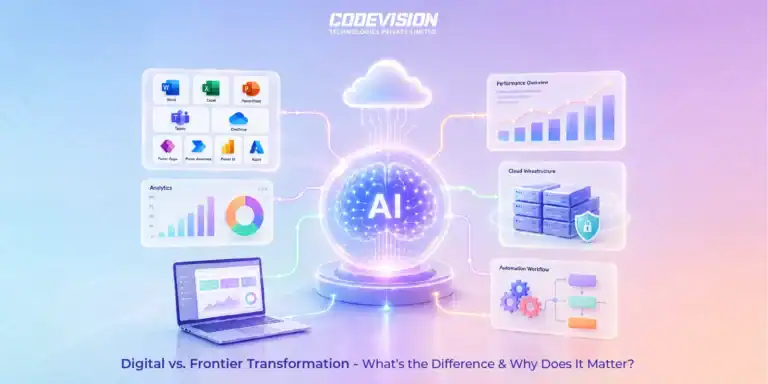
7 min readDigital Transformation vs. Frontier Transformation: What’s the Real Difference?
Digital transformation digitized business processes. Frontier Transformation goes further by combining AI, automation, intelligent agents, and connected systems to create smarter, AI-powered enterprises.

Power Platform
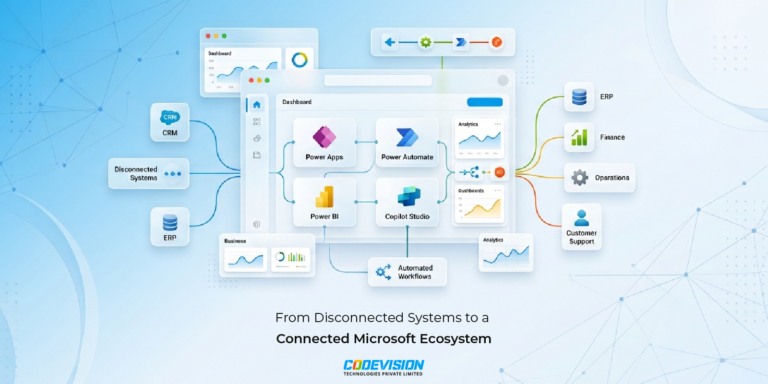
9 min readHow Microsoft Power Platform Powers Frontier Transformation for Modern Enterprises
Move beyond automation with Microsoft Power Platform. Connect data, processes, and applications to streamline operations and accelerate business growth.
Microsoft 365
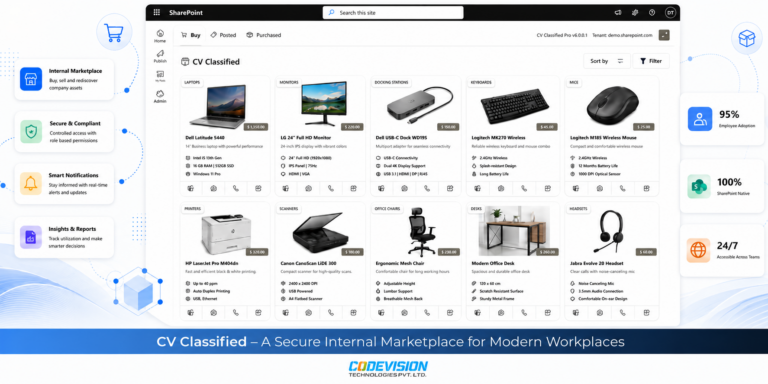
8 min readWhy Companies Lose Thousands on Unused Office Assets Every Year
Unused office assets often lead to duplicate purchases and unnecessary costs. Learn how CV Classified helps organizations reuse existing assets through a secure SharePoint-powered internal marketplace.